"Odor" and "Fragrance" — A Conversation with Genbei Yamaguchi, 10th-Generation Head of Konda-ya Genbei


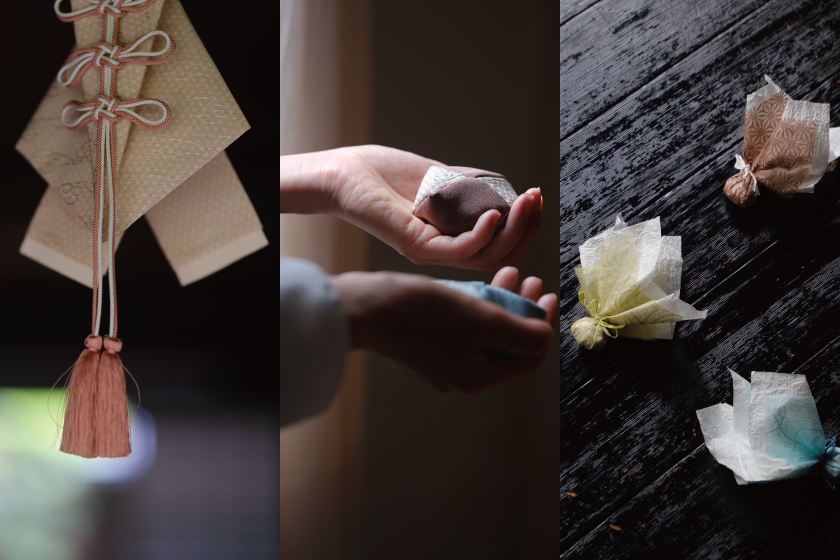
We spoke with Genbei Yamaguchi, the tenth-generation head of Konda-ya Genbei, the long-established Kyoto obi maker who collaborated with KOTOSHINA on our fragrance products, about the story behind the "sachet."

In modern usage, the word "niou" often appears in everyday contexts, much like the more negative sense of "smelling of something."
But it can also describe a subtle presence or atmosphere. In the Heian period, "niofu" appears throughout the Man'yōshū and Kokin Wakashū as an expression conveying beauty in waka poetry.
From the Kokin Wakashū, Book 6:
Though the color of the blossoms may be lost among the falling snow, let at least their scent drift out, so that others may know where they bloom.
This poem, well known as one composed by Ono no Takamura in memory of Sugawara no Michizane, who so loved plum blossoms, uses "ka" (香) to refer to the plum blossom itself, while "nioi" (匂い) conveys the space and atmosphere surrounding it.
 "Color and scent are deeply connected. I often tell my staff at Konda-ya this: there's actually no such thing as 'peach color' on its own — it comes from the whole experience of the peach blossom and the peach's flavor together. The scent of cherry blossoms is the scent of the entire scene, the whole space where they bloom in full glory — a scent that exists even without the tree itself physically there. 'Kaori,' by contrast, is something truly, tangibly present in that moment. That's actually the reason it's called a 'nioi-bukuro,' a scent pouch — its role is to fill a room with that presence. It's not simply about being filled with fragrance, though of course it does that too. It also served the role of purifying the air throughout the entire room."

 "What matters most is that KOTOSHINA, with its flagship store on the first floor of Kyoto BAL, chose to take on something like a scented sachet or a fragrant otedama — pieces of culture that are gradually being lost to time. That's not something you can do with a mindset purely focused on 'let's sell this.' There's a family motto at Konda-ya: 'Don't calculate before you create — what's truly genuine endures.' Embedded in that motto is the belief that you can't make something truly good if profit is your first concern, and that something genuinely good retains its value and gets passed down, no matter how the times change. True to that motto, our commitment to quality materials and traditional techniques passed down over generations is what draws so many people to our work. Even the obi I create tend to break every convention of Nishijin weaving — and that's exactly what sells.
 Recently, our design featuring bullfighting and octopus motifs became a surprise hit — honestly, I don't fully understand why it resonated so much. But because we make things with genuine sincerity, it takes far more time than simply making something designed to sell — much like Parisian haute couture. What matters is that KOTOSHINA isn't approaching this as mere business, but is genuinely trying to convey to its customers that this beautiful Japanese culture, passed down since the Heian period, still lives on here in Kyoto."
A Connection That "Niou" Through Gion Matsuri
In Kyoto, patterns passed down since ancient times, including Yakumo, can be spotted in all sorts of places — from the lavish decorations and costumes of the floats displayed at Gion Matsuri, to the yukata worn by those pulling the floats and playing festival music. Kyoto's long history is woven together through festivals and traditional events like these, and it turns out the connection between BAL and Mr. Yamaguchi is itself tied to Gion Matsuri.
"The current president and I are childhood friends — we used to run wild together as kids. In summer, the floats of Gion Matsuri were our playground. Back then, there was only one house in the neighborhood with a TV, and all the kids would gather there, at the doctor's house, every night at 7 o'clock. About 65 years have passed since then, and now here we are, creating something together — it really is a strange kind of connection, isn't it? (laughs)"
Looking it up, I found that in classical dictionaries, "niofu" also carried meanings like "to receive a blessing" or "to flourish under someone's influence."
From The Tale of Genji, Chapter 31, "Makibashira":
Even those connected to them come to share in that same blessing, it seems.
Connections, too, it seems, can "niou." Mr. Yamaguchi, we look forward to your continued partnership with BAL and KOTOSHINA.
Konda-ya Genbei × Shoyeido × KOTOSHINA Collaboration Fragrance Products
For more details, please see here